

Some dogs need a minute.
In which Jill maintains that the dogs are easy; finding their people is hard.

Remember that song in The Sound of Music, “How do you solve a problem like Maria?” A chorus of exasperated nuns laments their efforts to turn an unruly young governess into someone sensible and orderly, like a neatly folded napkin. They compare correcting Maria to “holding a moonbeam in your hand.”
That’s how I feel about our dog, Frisbee.
He’d been found wandering the streets of Long Beach. That alone isn’t remarkable; dogs escape their yards every day. But Frisbee is a Panda German Shepherd, the kind of dog people pull their cars over to photograph. Strikingly handsome, movie‑star regal and, like so many shepherds, he was spinning in his kennel at the shelter.
Melanie, Director of Long Beach Animal Services, stretched whatever rules she could stretch. She extended his deadline so we could come for him, because sometimes that’s what mercy looks like: one more day on the clock, one more chance to figure it out.
“He’s not focused enough for detection work, but he sure is a fun dog.”
We rescued Frisbee in October. He’s been in board‑&‑train for most of that time, our little moonbeam learning new skills.
When we’re trying to really know a shelter dog, we treat their life like a set of open doors. We walk them through and see what lights up. Frisbee has gone hiking, taken a whirl at an agility course, stayed in a sober living house, worked with professional trainers, even appeared on TV. This dog has a résumé.
He’s done well with all of it. Well, maybe not the agility course. He trotted through the chute like, “Okay, I did your weird nylon tunnel,” then turned to shepherd‑whisperer Jennifer Downs with a look that said, with perfect clarity, “Is it play time yet?”
Jenn was evaluating him as a potential detection dog. Frisbee was evaluating the availability of a tennis ball. We have videos of him at the agility field, being his wacky, distractible, people‑pleasing self. At some point Jenn stopped evaluating and started playing. She gave Frisbee a tug rope and played fetch with him. By the end of the afternoon, all three of us were grinning like kids who’d stayed too long at recess.
We spend a lot of time looking for people we’ve never met.
Here’s the part that breaks my heart in slow motion: Frisbee doesn’t make that instant connection people think they’re entitled to. He’s sensitive to touch, not in a dramatic way—no growling, no teeth, no story‑worthy incident for the Nextdoor app. He simply flinches, turns his head, and avoids eye contact.
When it comes to strangers, Frisbee just needs a minute.
But we live in a world that doesn’t really believe in “a minute” anymore. People want Wi‑Fi speed in a living creature. They meet him for ten seconds, and you can watch them slipping away. Their stories about the kind of dog they wanted rush in to fill the space where curiosity could have been.
“He didn’t connect with me,” says the confident husband who insists on speaking German to every dog he meets, as if language were the missing ingredient.
“I want a dog who will cuddle,” says the empty‑nester mom who’s decided she deserves a Hallmark ending, preferably in under thirty minutes, with snacks.
I wish they could see what I see. I wish they could see Frisbee lean his full shepherd weight against a favorite human and allow her to brush his coat, eyes soft, big smile. I wish they could see his goofy joy on the A-frame at the agility course. I wish they could watch him relish praise and affection after he aborts a “Find it!” command because something more interesting fluttered by…like a bird, or a thought.
What’s the job of a rescuer, anyway?
Frisbee is a conundrum packed into a shepherd’s body and a stand‑up comic’s brain. He is funny and wary, affectionate and reluctant, athletic and avoidant. He is both “yes” and “not yet” in the same dog. As his rescuer, my job isn’t to sand down the contradictions; it’s to tell the truth about them. To represent him as he is, not as an idea.
We have photos and videos and even a TV segment to show potential adopters. We’re genuinely proud of the way Frisbee’s turned out, considering where he started and how loudly the euthanasia clock was ticking.
But at the end of the day, the person who adopts Frisbee has to be able to see not just who he is, but who he could be. They need a little imagination. With all his quirks, Frisbee is that once‑in‑a‑lifetime dog who will fit beautifully into a pack—bonus points for a helper dog who can show him the ropes—and then claim his spot on the dog bed when it’s time to watch TV. Dogs and kids, yes please. Cats, not so much.
Sometimes I feel like I’ve written this story a hundred times. At Outta the Cage, we’ve rescued more dogs than I can count. Thousands now. Each one is special in their own weird and surprising way. But I lie awake wondering: are we really capturing their magic? Are we being true to their spirits, or are we just sharing what we think people want?
There is only one Frisbee.
Outta the Cage doesn’t rescue dogs by email request. We don’t peruse a shelter list from the comfort of a laptop. And, sadly, we don’t rehome dogs for friends of friends.
We rescue dogs we’ve actually met, whose poop we’ve picked up and whose stories have lodged themselves in our psyches. Dogs we believe we can not only place but represent.
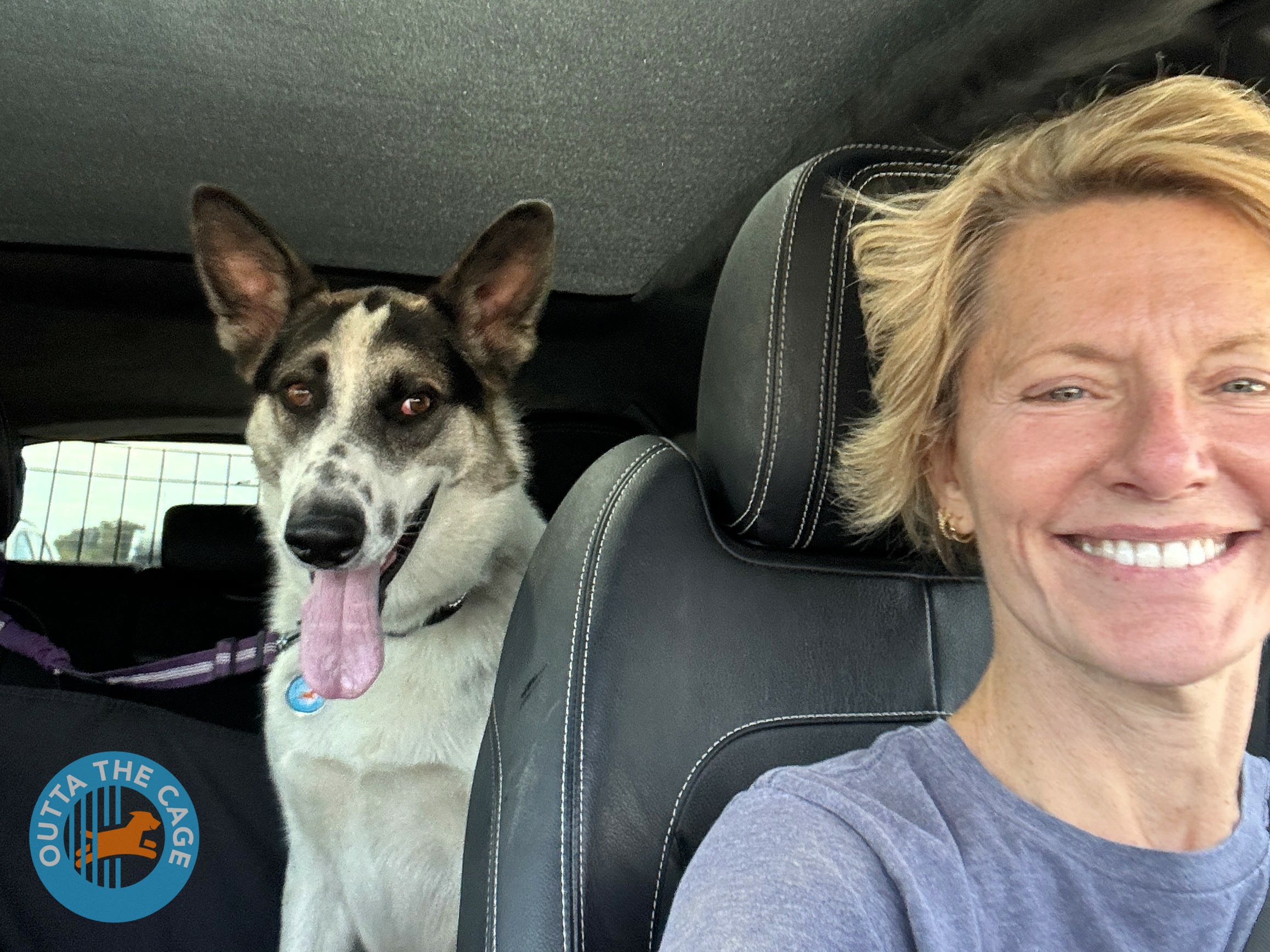
We live for those before‑&‑after photos: the dog who once cowered in the back of a kennel now sleeping belly‑up on a couch; the adopter with the wet hair and bigger smile because the rescue dog has just joined her in the swimming pool; the dog in the passenger seat, riding shotgun into a life that is finally, blessedly, his.
Frisbee can be that dog. I know it in my bones. It shouldn’t be as hard as it has been to find this sweet, complicated creature a family. Hard like—well, like the nuns would say—“holding a moonbeam in your hand.”
But here’s what I’ve started to believe: when you catch a moonbeam in your hand and let it go, it doesn’t disappear. It looks for somewhere to land. It slips under a cracked door, into a comfortable living room, and finds the person who didn’t yet know they were ready for a dog like Frisbee. And then, very quietly, it begins to light up their world.
Maybe our job isn’t to solve the “problem” of Frisbee at all. Maybe our job is just to keep holding him up to the light, again and again, until the right person finally recognizes that the strange, shimmering thing they’ve been looking for is here, waiting for them to take a minute, and then another, and then a lifetime.
My daughter and her husband are fostering a 2 year old German Shepherd. Her puppies were adopted from a shelter but not Daisy, and here in LA she was going to be euthanized. Daisy was abused in some way, is missing part of one ear, and is understandably cautious around new people and new dogs. But she’s wonderful, gentle with her little dog and cat housemates and so smart. We know her person/people are out there— but she needs a quiet minute, not a crowded adoption fair to meet that right person. This truly hit home for me.
Jill, you’re such a beautiful writer. This is the only blog I read.